
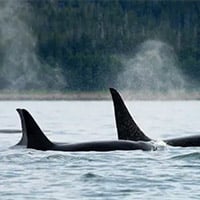


The thought of whale-watching in Southeast Alaska evokes in some people visions of shiny black orcas — killer whales — the largest of the dolphin family that hunt the world’s oceans for seals, sea lions, or salmon. Who doesn’t recognize their stout, starkly-patterned black and white bodies?And who isn’t chilled by the sleek, black foreboding dorsal fin of a large male orca when it silently punctures the surface of the water, slicing the air, forewarning the massive, toothy jaws beneath the surface? We do not see these marauders as often, but when they arrive on the scene, they always steal the show.
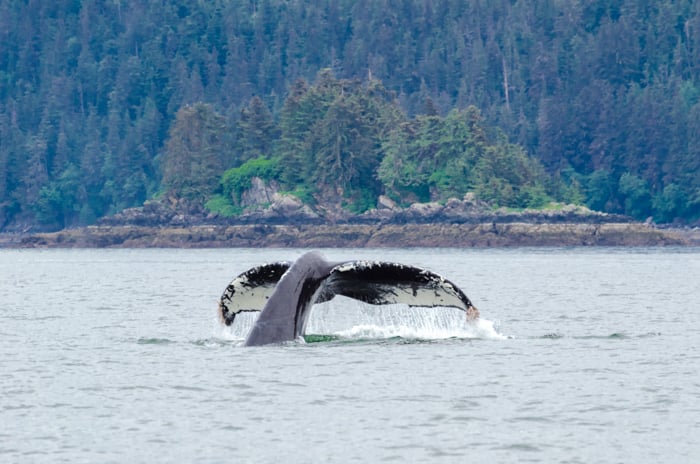
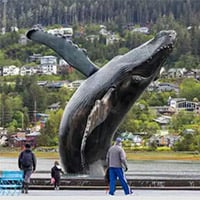
More often, we encounter mighty humpbacks—huge rorqual whales with deeply furrowed, expanding throats; mouths lined with shaggy baleen for trapping herring and krill; lungs the size of an SUV spewing gaseous geysers that can be seen from five miles away; and broad flukes powered by massive peduncle muscles capable of launching their 80,000 pound bodies out of the water in one of the most dramatic displays in the animal kingdom.
In my role as guide to visitors arriving in Juneau by cruise ship, I treat guests to humpback whale sightings every day. In fact, not only do we see them every day, but they find their way to the center of nearly every conversation I have with my guests. Even when teaching visitors about glaciers, bears, or salmon, inevitably—even necessarily—talk eventually comes around to humpback whales. They are a keystone species who trigger a trophic cascade on which everything else in the ecosystem depends. Without them, everything breaks down. But giant humpbacks and their lesser-seen orca cousins are not the only whales to be encountered in Juneau. In fact, sometimes I find neither to be the most exciting whales I encounter on the Inside Passage.

Photo by Jim Pfitzer
Cruising the waters of Southeast Alaska are a species of whales that are much smaller than humpbacks and orcas. At six to eight feet long and three to four hundred pounds, Dall’s porpoises are short and stout with white side patches and white-tipped dorsal fins. Like orcas, they are toothed whales. Hunting at night, they reach speeds of 30 knots in their pursuit of small schooling fish or squid. During the day, Dall’s porpoises can be seen playfully porpoising on the surface, their dorsal fins creating perfect rooster-tail sprays behind them as they race through the fjord. And, sometimes, these playful porpoises employ people as playmates. Last summer, I had one such encounter.
We were cruising north at about 29 knots along the east shore of Shelter Island when I saw the telltale rooster tails. I tapped Captain Lee’s shoulder and pointed. He pulled back on the throttle, maintaining our course at about 12 knots. I directed our guests’ attention out the window just as three dorsal fins broke the surface fifty yards from the boat.
Even if we had maintained our original speed, these high-spirited hunters could have outrun our boat, but they were not interested in racing. They were coming over to play. In no time, the speedy porpoises were on our bow wave, gracefully riding the swell. I invited some guests to join me on the bow, others stayed in the cabin and leaned out the windows. We snapped photos and laughed in awe at these little whales who seemed to enjoy us as much as we enjoyed them. Rising up through the bow wave, the porpoises stretched the surface of the water over their slick backs, the surface tension creating dreamlike patterns before breaking. Slipping side-to-sideup and down, they were as graceful as figure skaters unbound by ice.

Photo by Jim Pfitzer
The whole encounter lasted only a few minutes, but even after seeing several humpbacks on that tour, when we returned to the harbor a couple hours later, the talk of the trip was not the giants my guests had expected, but the completely unexpected and relatively diminutive whales. Whether it was the unexpectedness of the encounter, the close range, or perhaps the intentional engagement with the boat that made such an impression, there was no doubt what my guests would still be talking about over supper that evening.
I took thousands of photos of humpback whales, and hundreds of photos of orcas last summer, but the couple dozen pictures I captured of the Dall’s porpoises on that afternoon are the ones I find myself returning to time and again this winter. It is February and whale season is, once again, fast approaching. Soon, I will be wowed by breathtaking displays of hefty humpbacks and elegant orcas, but rest assured, I will always have an eye on the horizon, hoping for a visit from the other whales—my frolicsome friends, the Dall’s porpoises.
Photo by Adam Knudsen
About the Author: Jim Pfitzer is about to begin his second season as a guide for Gastineau, and his second year as an an Alaskan. He was born and raised in Chattanooga, TN, but has moved all over the country pursuing wild places and even wilder experiences. When asked about himself, Jim says he would rather paddle a canoe than drive a car, and prefers watching birds to watching television. “That about sums me up,” he says.

Photo by Adam Knudsen
About the Author: Jim Pfitzer is about to begin his second season as a guide for Gastineau, and his second year as an an Alaskan. He was born and raised in Chattanooga, TN, but has moved all over the country pursuing wild places and even wilder experiences. When asked about himself, Jim says he would rather paddle a canoe than drive a car, and prefers watching birds to watching television. “That about sums me up,” he says.